
Ray Kroc Net Worth: How the McDonald’s Visionary Built a Billion-Dollar Fast-Food Empire

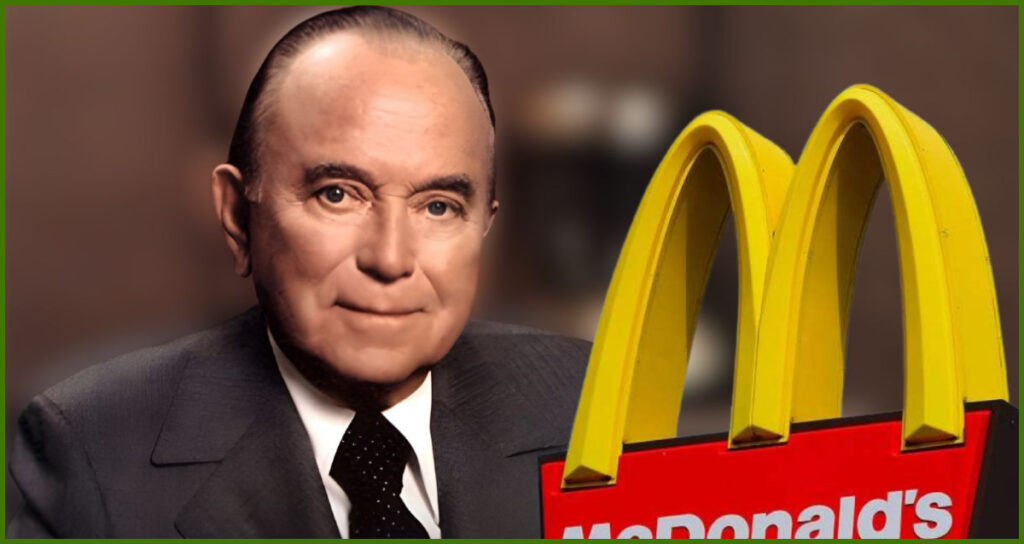
What Was Ray Kroc’s Net Worth?
At the time of his death in 1984, Ray Kroc had an estimated net worth of $600 million. Adjusted for inflation, that figure would be roughly $1.4 billion in today’s money.
Kroc transformed a small California burger operation into the global powerhouse known as McDonald’s. While he is often referred to as the company’s founder, the original restaurant was started by the McDonald brothers. However, it was Kroc’s business strategy and relentless expansion model that turned the brand into a worldwide phenomenon.
Ray Kroc Net Worth at a Glance
| Category | Details |
|---|---|
| Full Name | Raymond Albert Kroc |
| Born | October 5, 1902 |
| Died | January 14, 1984 |
| Age at Death | 81 years old |
| Estimated Net Worth (1984) | $600 million |
| Inflation-Adjusted Value | ~$1.4 billion |
| Main Source of Wealth | McDonald’s Corporation |
| Other Ventures | San Diego Padres (MLB) |
Early Life and Background
Raymond Albert Kroc was born on October 5, 1902, in Oak Park, Illinois, a suburb of Chicago. Raised by Czech-American parents, Kroc grew up during a time of economic instability. His father initially made significant gains through land speculation in the 1920s but lost everything during the 1929 stock market crash.
As a teenager, Kroc lied about his age to serve as a Red Cross ambulance driver during World War I. Interestingly, he trained alongside Walt Disney, although the war ended before either saw combat.
In the years that followed, Kroc worked various jobs, selling paper cups, playing piano in bands, and working in real estate, all while navigating the economic devastation of the Great Depression.
How Ray Kroc Built His Fortune
The McDonald’s Opportunity
After World War II, Kroc worked as a milkshake mixer salesman. This job led him to a small but efficient burger restaurant run by brothers Richard and Maurice McDonald.
Impressed by their streamlined kitchen system, Kroc saw a much bigger opportunity. In 1955, he joined as a franchise agent and began expanding the brand nationally. By 1961, he purchased full control of the company for $2.7 million.
That acquisition would prove to be one of the most profitable business decisions in modern history.
The Business Strategy That Changed Fast Food
Kroc didn’t just expand McDonald’s — he redefined franchising.
His core innovations included:
- Strict operational uniformity across locations
- Standardized menus nationwide
- Cleanliness requirements
- Centralized quality control
- Real estate-driven franchise model
With help from financial strategist Harry Sonneborn, Kroc ensured that McDonald’s corporate owned the land beneath many franchise locations — a move that secured long-term financial stability.
By the time of his death in 1984:
- McDonald’s operated over 7,500 U.S. outlets
- Expanded into 31 countries
- The corporation was valued at approximately $8 billion
Today, McDonald’s remains one of the most valuable restaurant brands in the world.
Other Income Sources
1. McDonald’s Stock & Dividends
Kroc accumulated wealth primarily through equity ownership and stock appreciation after the company went public.
2. San Diego Padres Ownership
In 1974, Kroc purchased the San Diego Padres baseball team. Although the franchise was not as financially successful as McDonald’s, it diversified his assets and strengthened his public profile.
3. Real Estate Holdings
Kroc owned multiple properties, including a 554-acre ranch in California’s Santa Ynez Valley, known locally as the “Hamburger House” due to its circular design.
Real Estate and Assets
One of Kroc’s most notable properties was the “J and R Double Arch Ranch,” purchased in 1965 for $600,000 shortly after McDonald’s went public.
The estate featured:
- A 17,000-square-foot lodge
- A dining room seating 100 guests
- A 5,200-square-foot conference hall
- Expansive valley views
The property was later listed for $29 million in 2020.
Kroc used the ranch for executive retreats and business research, blending leisure with corporate strategy.
Personal Life and Marriage
Kroc was married three times. His third wife, Joan Kroc, inherited the majority of his estate.
At the time of her death in 2003, Joan Kroc’s fortune was estimated at $3 billion. She donated nearly all of it to charity, including $1.5 billion to The Salvation Army.
Had those assets remained invested in McDonald’s stock, financial analysts estimate the fortune could have exceeded $18 billion at current valuations.
Net Worth Breakdown (Estimated)
| Income Source | Estimated Contribution |
|---|---|
| McDonald’s Equity | Majority of wealth |
| Stock Appreciation | Significant |
| MLB Ownership | Moderate |
| Real Estate | Multi-million-dollar assets |
| Investments | Undisclosed |
Was Ray Kroc the True Founder of McDonald’s?
Although Kroc is widely credited with building McDonald’s into a global empire, the original concept was created by the McDonald brothers.
However, from a corporate and brand-building standpoint, many business historians consider Kroc the architect of the modern McDonald’s system.
Frequently Asked Questions
What was Ray Kroc’s net worth when he died?
Ray Kroc’s estimated net worth was $600 million in 1984, equivalent to approximately $1.4 billion today after inflation adjustment.
How did Ray Kroc make his money?
He built his fortune primarily through expanding and franchising McDonald’s, along with stock ownership and real estate holdings.
Who inherited Ray Kroc’s money?
His third wife, Joan Kroc, inherited most of his estate and later donated nearly all of it to charity.
Would Ray Kroc be a billionaire today?
Yes. Based on inflation and McDonald’s stock growth, his wealth would likely exceed $1 billion today.
Final Thoughts
Ray Kroc’s story is not just about burgers, it is about vision, discipline, and scalability. From modest beginnings in Illinois to building one of the most recognizable brands on earth, his financial legacy remains a case study in modern capitalism.
While his fortune was enormous, what makes his story even more remarkable is how much of it was eventually given away for charitable causes.
For entrepreneurs worldwide, especially in Africa, Asia, the UK, and the United States, Ray Kroc’s journey proves that identifying scalable systems can create generational wealth.