
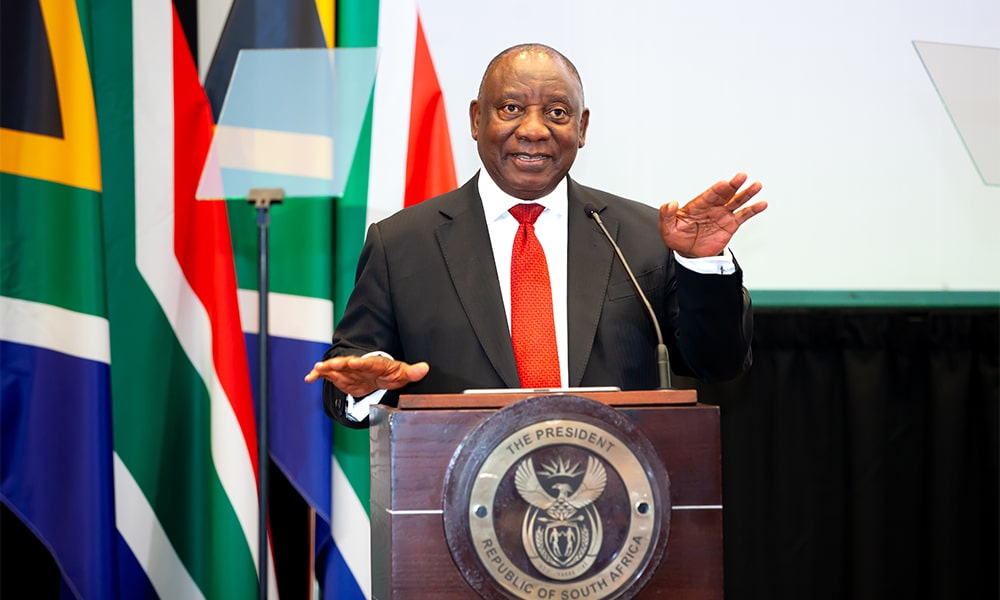
The President of South Africa, Cyril Ramaphosa, is among the most influential leaders on the African continent. A seasoned anti-apartheid activist and a qualified lawyer and businessman, President Cyril Ramaphosa was born in Johannesburg on November 17, 1954.
He is well known for contributing enormously to negotiations that put an end to apartheid, which guided South Africa towards a democratic, non-racial country. Ramaphosa was elected as the president of South Africa in 2018, and since 2017, he has been the leader of the ruling African National Congress.
Early Life, Education, and Activism of the President of South Africa
Cyril Ramaphosa was born to Samuel Ramaphosa and Erdmuth Ramaphosa at the nadir of South Africa’s apartheid policies. Ramaphosa spent his early years of growth at Western Native Township in what was then Transvaal Province, now Gauteng Province. In 1962, he was relocated to Soweto; this was a common occurrence for Blacks during apartheid policies.
In 1972, Ramaphosa accepted a spot at the University of the North, which is now referred to as the University of Limpopo, to pursue a law degree. During his studies, he got deeply involved in student politics. His devout Christian upbringing enabled him to participate actively in the Student Christian Movement. In addition, his emerging political consciousness led him to the South African Student Organisation.
READ ALSO: Top 5 Most Powerful Countries in Africa (2026)
Ramaphosa’s activism put him at loggerheads with the apartheid regime. In 1974, he was arrested for organizing a rally to commemorate the end of colonial rule in Mozambique, in which he actively participated. He was subjected to 11 months of solitary confinement.Ramaphosa went back to organizing after his release, but through the Black People’s Convention.
Subsequent to the Soweto Uprising in 1976, Ramaphosa was arrested again, this time being detained for six months while in solitary confinement. Despite his multiple arrests, he pursued his studies on a part-time basis, finally graduating from the University of South Africa (UNISA) in 1981, earning a B.Proc. degree.
Rise to National Prominence
In the 1980s and early 1990s, Ramaphosa emerged as a central figure in South Africa’s transition away from apartheid. He played a leading role in labor organizing and later became one of the ANC’s chief negotiators during talks that dismantled apartheid and laid the groundwork for democratic elections.
His negotiating skills and political pragmatism earned him widespread respect both within South Africa and internationally.
Presidency of South Africa
Ramaphosa assumed office as president in February 2018, inheriting a country facing serious structural challenges. These included chronic electricity shortages, weak economic growth, and widespread public concern over corruption linked to state institutions.
One of his administration’s early priorities was restoring trust in government. Investigations were launched into corruption allegations at several state-owned enterprises, including Eskom, the national electricity utility. His government also established a special tribunal to fast-track corruption cases and recover misappropriated public funds.
Political Challenges and Policy Debates
Despite his reformist image, Ramaphosa has faced internal resistance within the ANC. Divisions within the party have forced compromises on key policy issues, particularly land reform.
Although Ramaphosa had previously supported a more moderate approach to land redistribution, political pressure led him to back policies allowing expropriation of land without compensation, a position strongly supported by factions within the ANC and the opposition Economic Freedom Fighters (EFF).
2019 Election and Second Term
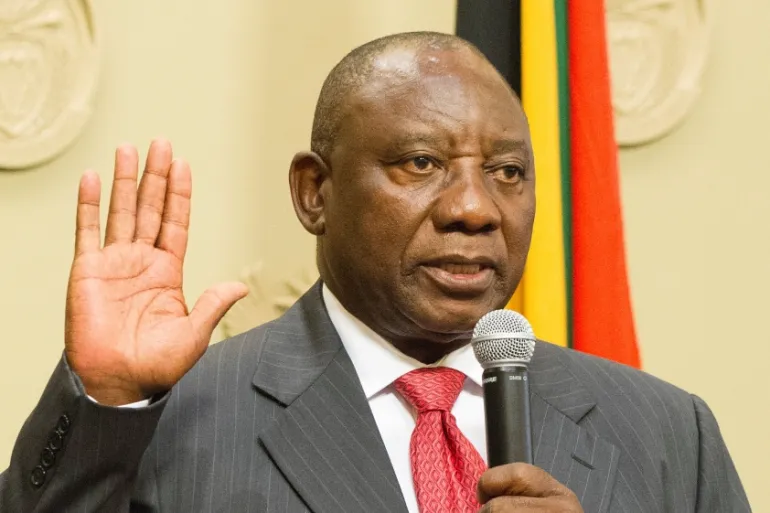
South Africa held national elections in May 2019, with the ANC securing victory by its narrowest margin since coming to power in 1994. Ramaphosa was re-elected president by the National Assembly and was sworn in for his first full term on May 25, 2019.
His cabinet attracted attention for achieving gender parity, marking the first time South Africa formed a cabinet with women holding half of all ministerial positions.
Leadership During the COVID-19 Pandemic
In 2020, South Africa was heavily affected by the COVID-19 pandemic, worsening economic conditions and exposing long-standing inequalities in healthcare and income. Ramaphosa declared a national state of disaster in March 2020, which remained in effect until April 2022.
His early handling of the crisis received praise for decisiveness, though public support declined over time as lockdowns persisted and economic pressures mounted.
Legacy and Influence
Cyril Ramaphosa’s presidency has been defined by efforts to balance reform, political unity, and economic recovery. While challenges remain, he continues to play a central role in shaping South Africa’s domestic policies and its standing within Africa and the global community.