

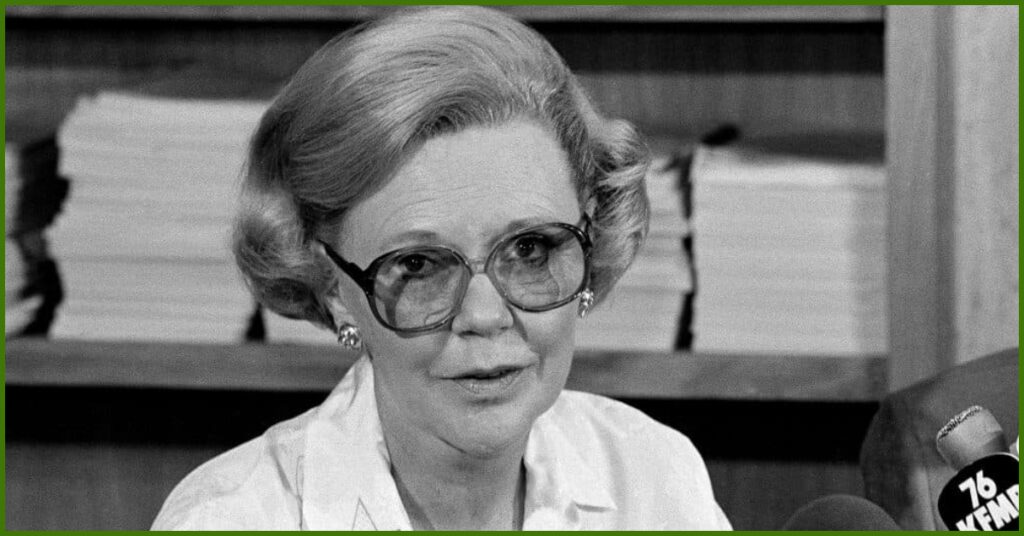
Joan Kroc was an American philanthropist, peace advocate, and the third wife of McDonald’s magnate Ray Kroc. While many recognize her as the widow of the man who expanded McDonald’s into a global empire, Joan built a legacy that far outshone her association with fast food.
By the time of her death in 2003, she had donated billions of dollars to humanitarian, educational, and peace-building causes—making her one of the most generous philanthropists in American history.
Early Life and Background
Joan Beverly Mansfield was born on August 27, 1928, in West St. Paul, Minnesota, United States. Her father, Charles Smart Mansfield, worked as a storekeeper before becoming a railroad telegraph operator and salesman. Raised in a modest household, Joan developed strong religious values and a passion for music at a young age.
She was especially talented at playing the organ—an interest that would later change the course of her life.
First Marriage and Family Life
In 1945, Joan married Rawland F. “Rollie” Smith, a Navy veteran who later became a successful McDonald’s franchise owner in Rapid City, South Dakota. The couple welcomed their only child, a daughter named Linda, in 1946.
During this period, Joan balanced family life while nurturing her love for music and community involvement.
How Joan Kroc Met Ray Kroc
Joan first met Ray Kroc in 1957 while she was playing the organ at the Criterion Restaurant in St. Paul, Minnesota. At the time, both were married to other people. According to Ray’s autobiography, he was immediately captivated by her.
They reconnected at a McDonald’s conference in 1969. Within six months, both had divorced their spouses and married each other. Their relationship marked a new chapter in Joan’s life—one that would eventually place her at the helm of a vast fortune.
When Ray Kroc died in 1984 in San Diego, California, Joan inherited the bulk of his estate.
Joan Kroc’s Philanthropy: A Billion-Dollar Impact
Unlike many wealthy heirs, Joan Kroc chose to distribute her fortune on an unprecedented scale.
The Salvation Army Kroc Centers
One of her most transformative contributions was to The Salvation Army.
- She funded the first Kroc Center with an $87 million donation.
- Upon her death, she left $1.5 billion to expand Salvation Army Kroc Centers across the United States—the largest single bequest ever made to the organization.
These centers provide community services, education programs, sports facilities, and outreach support for underserved populations.
Support for Peace and Justice Institutions
Joan believed deeply in conflict resolution and nuclear disarmament. She funded multiple institutions dedicated to peace studies, including:
- The Joan B. Kroc Institute for Peace and Justice at the University of San Diego
- The Joan B. Kroc Institute for International Peace Studies at the University of Notre Dame
Her contributions helped establish academic programs focused on diplomacy, human rights, and global conflict prevention.
Major Donations to National Public Radio (NPR)
In 2003, it was revealed that Joan Kroc donated $225 million to National Public Radio (NPR), including support for San Diego’s KPBS station. This remains one of the largest gifts in public broadcasting history.
Political and Social Activism
Joan Kroc was not a silent philanthropist. She actively supported nuclear disarmament campaigns in the 1980s, funding advertising efforts and reprinting books that advocated for reducing nuclear weapons.
Her outspoken views drew criticism from some conservative commentators, but she remained firm in her convictions about global peace and humanitarian responsibility.
She also quietly donated $15 million to help Grand Forks, North Dakota, and East Grand Forks, Minnesota, rebuild after devastating floods in 1997. Residents later referred to her as an “angel” for her anonymous generosity.
Death and Legacy
Joan Kroc died of brain cancer on October 12, 2003, in Rancho Santa Fe, California, at age 75. She was cremated and entombed at El Camino Memorial Park in San Diego.
Her will included historic charitable bequests:
- $1.5 billion to The Salvation Army
- $200+ million to NPR
- $50 million to peace institutes at the University of San Diego and University of Notre Dame
- $20 million to San Diego Hospice & Palliative Care
Her estate distribution cemented her status as one of the most impactful female philanthropists in American history.
Joan Kroc’s Lasting Influence
Though often introduced as Ray Kroc’s widow, Joan Kroc created a legacy defined by compassion, activism, and transformative giving. Her donations reshaped public broadcasting, peace education, and community development across the United States.
Today, her name lives on through Kroc Centers, university institutes, and humanitarian initiatives that continue to serve millions.


One Comment